Yes, adults can get braces or clear aligners, and many orthodontic patients today are adults. The biology that moves teeth works the same at 45 as at 15. What changes is the context: gum health and existing dental work.
Here is what adult treatment actually involves in Winter Haven, without the sales pitch.
Why are more adults starting orthodontic treatment?
Two things changed. The appliances got less conspicuous, and the reasons got more practical.
Most adults we see are not chasing a perfect smile for its own sake. They are dealing with lower front teeth that have crowded progressively for twenty years and are now difficult to clean. Or a bite that concentrates force on two teeth and has visibly worn them. Or a retainer abandoned in high school and the drift that followed. Or a general dentist who said a crowded space needs opening before an implant can go in.
How is adult treatment different from a teenager’s?
You are done growing
In a growing child, an orthodontist can influence jaw development. In an adult, the jaws are set. A problem rooted in jaw position rather than tooth position has fewer non-surgical options, and that distinction is one of the first things a proper examination establishes.
Gum and bone health is the gating factor
Teeth are held by bone, and moving a tooth means remodeling that bone. Where periodontal disease has reduced bone support, forces must be lighter and movement slower — and active gum disease has to be treated and stabilized before any appliance goes on. This is the single most important thing an adult workup checks.
Existing dental work has to be planned around
Crowns can be moved, though brackets bond differently to porcelain than to enamel. Bridges splint teeth together, so those teeth move as a unit or not at all. Implants do not move at all — an implant is fused to bone and becomes a fixed landmark the plan works around, occasionally a useful anchor. Old extraction sites where bone has resorbed can limit where a tooth can be moved to.
None of this rules out treatment. It means the initial records matter, and coordination with your general dentist is often part of the plan.
Braces or clear aligners: which is right for an adult?
| Braces (metal or ceramic) | Clear aligners | |
|---|---|---|
| Best suited to | Complex movement, rotations, vertical correction | Crowding and spacing within a moderate range |
| Visibility | Ceramic blends in; metal is visible | Very discreet at conversational distance |
| Depends on you | Little — they are fixed in place | Heavily — 20 to 22 hours of wear daily |
| Eating | Hard and sticky foods restricted | No restrictions; trays come out |
| Cleaning | Brushing and flossing take longer | Normal routine; trays cleaned separately |
| Office visits | Adjustments every several weeks | Generally fewer, often shorter |
The case for braces
Fixed appliances remain the most capable tool available, and they remove compliance from the equation entirely. For significant rotations, large gaps, or teeth that need to move vertically, braces will usually finish faster and more predictably. Ceramic brackets keep them reasonably discreet for adults who want fixed treatment without the look of metal.
The case for aligners
They come out for meals, for a presentation, for photographs. Cleaning your teeth stays normal. For a working adult with moderate crowding, that convenience is genuinely valuable.
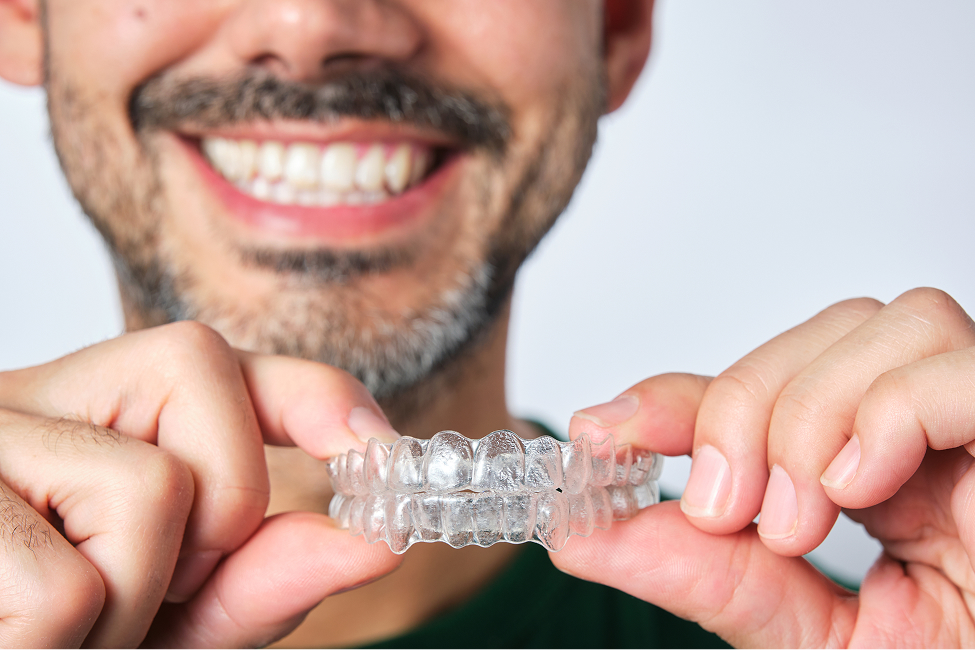
The honest caveat is wear time. Aligners work about 22 hours a day when they are in your mouth and zero hours a day when they are in your pocket. Patients who wear them as directed do well; patients who do not watch treatment stretch out with no one quite sure why. Our Invisalign page covers how the process works, and our adult braces page covers the fixed-appliance route.
Is there a middle option?
Often, yes, and it is underused. Short-course fixed appliances on the lower arch combined with aligners on the upper is a common hybrid: the lower teeth, which are usually the crowded ones, get the more capable appliance, while the visible upper arch stays discreet. Another version uses braces for a few months to handle the difficult movement, then switches to aligners to finish.
Hybrids are worth asking about specifically, because patients rarely know they exist and tend to frame the decision as one or the other.
What does treatment look like day to day?
With aligners, you take the trays out to eat and to drink anything other than water, brush before putting them back in, and change to the next set on schedule. The practical friction is social: restaurant meals, coffee with a colleague, anything unplanned. Patients who succeed usually build a habit around carrying the case everywhere.
With braces, there is nothing to remember and nothing to carry, but the food restrictions are permanent for the duration — nothing hard, nothing sticky, and hard fruit and crusty bread get cut rather than bitten. Cleaning takes longer, and an interdental brush or water flosser stops being optional.
Neither is difficult. They are different kinds of small daily discipline, and knowing which one you would resent less is genuinely useful in deciding.
How long does adult treatment take?
Most adult cases run somewhere between twelve and twenty-four months, with minor corrections finishing sooner. Bone turnover is a little slower in adults than in teenagers, which can add a few months to comparable movement.
Nobody can quote you a timeline before examining your teeth and taking records. Anyone who does is guessing.
What about cost and insurance?
Fees depend on the complexity of the case and the appliance, and we go through the specific number at your consultation rather than estimating over the phone. A few things that hold true generally:
- Orthodontic insurance benefits are usually a lifetime maximum, not an annual one, and many adult policies include orthodontic coverage that patients never check.
- FSA and HSA funds can be applied to orthodontic treatment. FSA dollars expire at the plan year, which makes start timing worth thinking about.
- Payment is normally spread across treatment with an amount up front and monthly payments, and there is usually more flexibility in that split than patients assume.
What happens at a first visit?
An examination, digital records, and a conversation. The scanning is painless — no tray of impression material, just a handheld scanner building a 3D model of your teeth over a few minutes. You can see more about the equipment on our technology page.
You should leave knowing what is actually going on with your bite, which approaches would work for it, roughly what each would involve in time and money, and whether treatment is worth doing at all. If we do not think it is, we will say so.
Frequently asked questions
Am I too old for braces?
There is no upper age limit. The relevant question is the health of your gums and the bone supporting your teeth, not the year on your birth certificate. A 65-year-old with healthy gums is a more straightforward case than a 35-year-old with untreated periodontal disease.
Will treatment affect my speech or my job?
Aligners cause a slight lisp for the first few days that resolves as your tongue adapts. Braces are generally unremarkable after the first week. Adjustment appointments are short and spaced several weeks apart.
Does it hurt?
There is soreness for a few days after an adjustment or a new set of aligners — a dull ache when biting rather than anything sharp. Over-the-counter pain relief handles it, and it fades as treatment progresses.
What if I have veneers?
Veneers can be moved, but bonding brackets or aligner attachments to porcelain requires different preparation than bonding to enamel, and there is some risk of chipping at debond. If you have invested in veneers, say so at the first visit — it changes how the case is planned, and in some situations sequencing matters, since teeth are better straightened before veneers are placed rather than after.
Can I be treated if I have crowns or implants?
Usually. Crowns and bridges can be worked with, and implants become fixed points the plan accommodates. Mention any existing dental work at your first visit so it can be factored into the records.
A reasonable first step
You do not need to decide on an appliance before you walk in. The useful first conversation is diagnostic. Our Winter Haven page covers the practical details of getting care with us, and you can schedule a consultation whenever you are ready for a real answer instead of an assumption.