
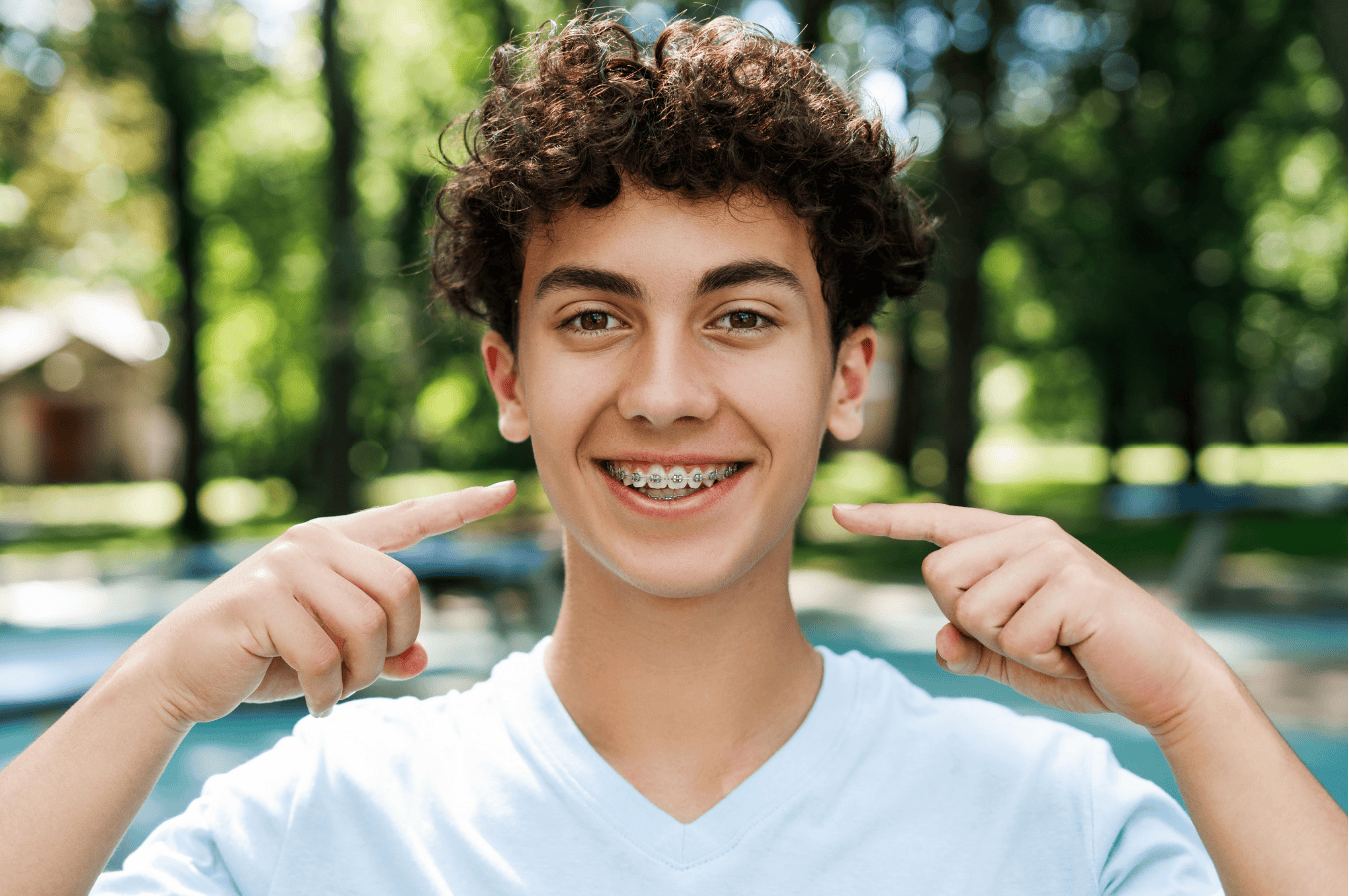
Gold braces are conventional metal brackets with a gold-colored finish. They work exactly like stainless steel braces, take the same time, and are chosen for appearance, not performance. If you want to be less noticeable, ceramic brackets are the better option.
Appearance is the first thing most patients ask about once braces are decided. Here is what genuinely changes the look, and what each choice costs you clinically.
Which parts of braces can you actually change?
Three visible components, and different options affect different pieces:
- The bracket — the small square bonded to each tooth. Available in stainless steel, tooth-colored ceramic, or a gold-toned finish.
- The archwire — the wire running through the brackets. Usually metal; frosted tooth-colored versions exist.
- The elastic ties — the small bands holding the wire into each bracket, available in a wide range of colors and swapped at every adjustment.
Most of the personality in a set of braces comes from that third item, which is also the only one you get to change every few weeks.
What are gold braces?
Stainless steel brackets with a gold-colored coating. They are not solid gold, and mechanically they behave like any other metal bracket — same strength, same efficiency, same treatment times.
What they change is tone. Silver brackets read as clinical. The warmer finish reads more like jewelry, and against certain skin tones and enamel shades it looks noticeably softer than steel. Patients who choose gold generally do so because they want their braces to look deliberate rather than hidden.
Do gold braces work differently?
No. Bracket finish has no bearing on how teeth move, how long treatment takes, or the final result. Anyone claiming a clinical advantage for gold is overselling.
Do they cost more?
Sometimes a modest premium over standard metal, depending on the bracket system. It is worth asking at your consultation, and it is a small figure relative to overall treatment cost.
How do the bracket options compare?
| Metal | Gold-toned | Ceramic / clear | |
|---|---|---|---|
| Visibility | Clearly visible | Visible, warmer tone | Blends with enamel |
| Durability | Highest | Same as metal | More prone to chipping |
| Treatment time | Baseline | Same as metal | Sometimes slightly longer |
| Relative cost | Lowest | Small premium | Higher |
| Staining risk | Ties only | Ties only | Ties only — brackets do not stain |
| Usually chosen by | Athletes, complex cases, budget-conscious families | Patients wanting a deliberate look | Adults and older teens wanting discretion |
Which colored bands should you choose?
The ties are where most kids and teens have their fun. They cost nothing extra, they change at every adjustment, and there is no wrong answer. A few things patients learn by trial and error:
- Darker colors make teeth look brighter. Navy, deep purple, and dark green contrast well against enamel.
- Clear and white are riskier than they look. Clear ties pick up stain from coffee, curry, and tomato sauce. White can make nearby enamel look duller by comparison.
- Yellow and gold-toned ties sit close to the color of stained enamel, which is not the association most people are after.
- Nothing is permanent. A color you dislike lasts until your next appointment, not until the end of treatment.
Are ceramic braces the better choice for discretion?
If blending in is the priority, yes. Ceramic brackets are tooth-colored or translucent and genuinely hard to notice from a few feet away, which is why adults and older teens gravitate toward them.
The trade-offs are modest but real. Ceramic is harder than steel yet more brittle, so brackets are likelier to chip under a sharp impact — a hard bagel, an elbow in a basketball game. The brackets are slightly bulkier, which can add a little friction and occasionally a few weeks to treatment.
One persistent myth worth clearing up: the ceramic brackets themselves do not stain. The elastic ties do, and those are replaced at every visit. Pair ceramic with frosted ties rather than clear ones and the problem largely disappears.
For patients whose priority is discretion above all, removable clear aligners are worth discussing too — our Invisalign page covers how those compare.
What other bracket colors and finishes exist?
Beyond the three main categories, a few variations come up:
- Rose gold and colored brackets. Some systems offer alternative finishes. Availability varies by bracket manufacturer, so ask rather than assume.
- Gold lingual braces. Lingual braces sit behind the teeth and are invisible from the front regardless of finish; some systems use a gold-toned alloy. They are the most discreet fixed option available and also the most demanding to adapt to, with a longer speech adjustment period.
- Tooth-colored archwires. A frosted coating on the wire itself, which meaningfully reduces the visual line running across your teeth when paired with ceramic brackets. The coating does wear at contact points over time.
What do appearance choices not change?
This is the part worth being direct about. Choosing gold over silver, or navy ties over green, has no effect on how long treatment takes, how well it works, or what it costs beyond a small bracket premium.
What does affect the outcome is the underlying appliance decision — fixed versus removable, ceramic versus metal for a case that needs heavy movement, whether elastics or additional appliances are required. Those are clinical calls made on what your bite needs. Once they are settled, the cosmetic choices sit on top and are entirely yours.
How do you keep braces looking good?
Whatever you choose, the finish depends on hygiene. Plaque left along the bracket margins demineralizes enamel and can leave permanent white marks that appear the day the braces come off — on the exact teeth you were trying to improve.
Brushing after meals, cleaning between the teeth daily, and easing off sugary drinks matter more to the final appearance than any bracket you pick.
Frequently asked questions
Are gold braces real gold?
No. They are stainless steel brackets with a gold-colored finish. They are not made of solid gold and are not priced like jewelry.
Can I change my bracket type partway through treatment?
It is possible but not usually advisable. Rebonding an entire arch means an extra appointment and additional cost with no clinical benefit. Choose at the start.
Do colored bands stain my teeth?
The bands themselves can stain, but they do not stain your teeth. What does mark enamel is plaque left sitting around the brackets, which is a hygiene issue rather than a color one.
Can adults get colored bands?
Of course. Plenty do, usually in subtler shades. There is no age rule attached to any of this.
Deciding
We go through the options at your consultation and, more usefully, show you the actual brackets in person — photographs online communicate scale badly.
You can read more about fixed treatment on our braces in Davenport, FL page or the equivalent for our Kissimmee office. When you want to talk specifics, schedule a consultation.